Saturday, July 22, 2023

Pfeil Gouge Rack


https://www.thingiverse.com/thing:6134612

I designed and printed a rotating turntable holder for my Pfeil palm gouges for lino and wood cutting. It holds up to nine gouges, and when assembled it stands about 170mm tall.

It requires a 22mm skateboard bearing for the turntable, and I added a couple of disks of baking paper under the cap to provide a low-friction surface.

I'll probably turn a wooden base for it to stand on at some point.


2023-07-26

I turned a base for the turntable from an old lump of rimu.

It's a raggedy, split bit of wood, and not a great piece of wood turning, but it will do the job.

I've also put the gouge number and profile on the top of the wooden mushroom, so that I can distinguish between them at a glance. It's not difficult to tell them apart by the blade when they're of a decent size, but the teensier tinier gouges all look quite similar to my tired old eyes.


2023-08-02

I made another one.

It's fundamentally the same as the first, just different in detail (and colour).

I included some countersunk holes around the bottom this time, so that it could be screwed to its wooden base instead of being glued.

Wednesday, July 19, 2023

Etching Press Modifications


A few years ago, after a small windfall, I bought myself this little intaglio press. It's sold by an Italian company called RGM, and it's fundamentally identical to the Fome portable press available from Jackson's. So similar in fact that I strongly suspect that they're all just pumped out of a factory somewhere in China and re-badged by the end sellers. It's a decent, fairly well-engineered, entry-level press that doesn't take up a lot of room, but it's not without its issues.


The hand-crank supplied with the press is just stamped from a sheet of mild steel, and it's not nearly strong enough. Mine started to bend when the press was under even moderate pressure. I replaced that with a cast iron pulley wheel taken from an old pump, and that works much better, although its spokes can interfere a bit with the pressure adjustment screw on that side.

The other major issue is the bed, which was just a piece of 270mm wide 3mm stainless steel. It was adequate, but the felts and paper and everything tended to slide on its surface when they came up against the roller. I replaced that with a piece of 12mm plywood, a bit longer than the original bed. The knurled lower roller grips the wood very positively, and the felts stay in place on top. There's a possibility that it may end up being warped by the pressure of the rollers, but if that happens it's a very cheap and easy thing to replace.

The third issue, and it's one that I don't think I can do anything about, is the diameter of the rollers. They're only 34mm in diameter, and ideally I'd prefer them to be at least double that. The small diameter means that there's quite a steep angle of attack when the roller meets the plate, which is not ideal. However, they do work, and the press will produce pretty good prints, up to about A4 in size.

Sunday, July 16, 2023

Print Drying Rack


I got sick of having fresh prints lying around all over the place, so I whipped up a drying rack for myself at long last.

It's just some lengths of 3mm MDF glued into angled slots in a couple of battens, and the battens glued to a bit of 9mm MDF. I put a couple of hooks on it to hang it, as shown here, or else I can use it down flat, with the prints resting on edge. The hanging version is more convenient, as it keeps the drying prints up and out of the way.

This rack will cater to up to sixteen prints, which should be plenty. I seldom do more than eight or ten at a time. It handles A4-ish paper fine, and should be able to support larger sheets as well, though that would depend on the weight of the paper. Anything more than about A3 would probably tend to droop at the ends, I would think.

Friday, July 14, 2023

Land of the Blind — Colour Test


I've completed my first run of colour tests for this print. It's six blocks (or seven if you count the one that was printed in two colours). The key block is EssDee Soft lino, all the others are 3mm MDF.

I don't know what this paper is; it's a scrap I fished out of a pile of scraps. It feels like about 240gsm or thereabouts, and I think it might be a hot-press  watercolour paper.

There's a tiny bit of cutting left to do, and then I think it's about done and ready for a proper print run.

Tuesday, July 11, 2023

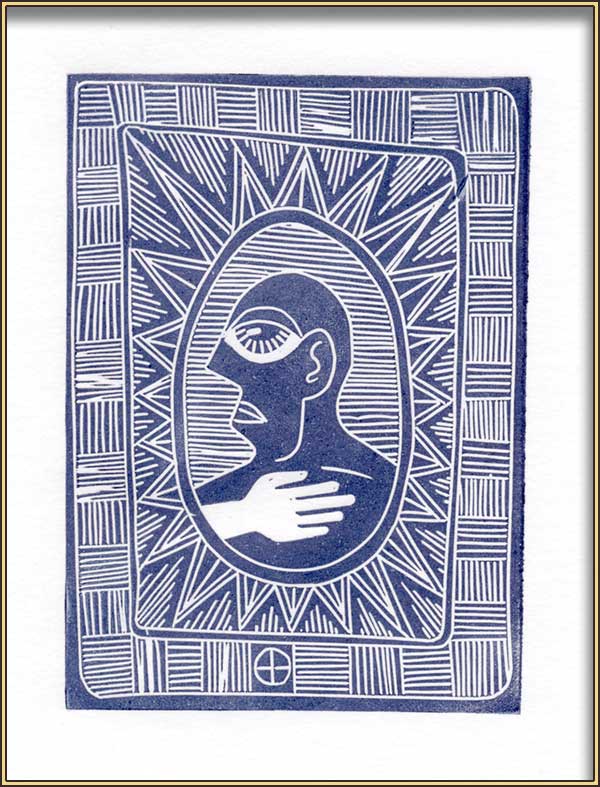
Land Of The Blind


Land of the Blind

"In the land of the blind, the one-eyed man is king"

Linocut, 105 x 150 mm


I have not yet decided whether or not to add a second or third colour block to this. I probably will, eventually.


Later on...

I bought myself a little Esselte lino cutter and a couple of blades, because I wanted a narrow U-gouge that I didn't have amongst all my other cutter profiles. It was cheap. Something I didn't anticipate is that the blades for these are sharpened with an inside bevel, unlike my woodcut gouges. That makes them quite a bit harder to sharpen, and also they tend to dive into the carving block rather than rising out of it — something to watch out for.


Next Day...

Starting to play with colour blocks now.

The registration isn't great, but that's not hugely important for this purpose.


Next Next Day...

I decided that I want the body of the king to be a different colour than his crown. But rather than cut a whole new block, and cut out the body area on the crown block, I just cut out the body with a jeweller's saw to make a sort of jigsaw arrangement.

This way I can ink up the two areas separately and then reassemble them and print them simultaneously, or else I can glue the body bit to a piece of paper the same size as the other blocks so that it will fit into the registration jig and be printed separately.

The jeweller's saw gives me a kerf of about half a millimetre, which would be enough to show up in a print as a perceptible white line, but it will be underneath the key block so it shouldn't be too obvious.


I transferred the image of the key block to the colour blocks by means of the offset transfer method, which is quick, easy, and effective. However, the black ink I used for the transfer is reactivated by the coloured inks on top of it, and a shadow image of the key line is printed along with the colour.

I expect that if I waited long enough the ink would cure enough to not be reactivated, but that would be a faff. Alternate strategies might be to do the transfer using a very light, transparent mix of ink, just visible enough to act as a cutting guide, or else to do it using an oil-based ink that would not be affected by the water-based inks going on over the top.

In truth, the shadow printing shouldn't affect the final print to any great degree, since the key block will be printed over the top of it. But I would quite like not to have it happen at all.

Sunday, July 9, 2023

Brayer Rack


I have half a dozen Speedball 3-inch brayers, in varying stages of abuse and degradation, and up until now they've just been knocking around wherever they might come to rest. I like the consistency of the Speedball brayers, though in truth the little 3-inch ones are really too small for most work, and the diameter of the roller will only give you a roll-out of about 90-95 mm.

It's not good for them to be left with anything pressing against the rubber of the roller; you can end up with dents and flat spots that may never come out again.

So today I've cobbled together a stand for them out of bits and pieces of plywood. It'll do the job, and eventually I'll probably get around to making a box to put it in.

Friday, July 7, 2023

Pfeill #11 Try-out


This is 75x105mm (in fact it's the back of this one:)


It's been cut entirely with the Pfeill #11 sweep/veiner I showed in my last post.

As you can see, there's almost no variation in line weight, as you would get when using a vee-gouge. It's kind of the block-printing version of a technical pen.

As an aside, clearing out the pure white areas with a #11 is a real pain. It's not something I would have done if I hadn't vowed to use no other tools on this piece.

Pfeill Modification


This is a Pfeill lino or woodcut gouge, made in Switzerland. They are excellent chisels, good steel, good ergonomics, and well made. There are cheaper ones available for sure, but with this sort of tool you tend to get what you pay for.

This specific one is a #11 sweep or veiner; it's a tiny U-gouge that creates a very regular fine line. It's not impossible to modulate the line, but there's not much scope for variation in the line it creates.


It's held with the mushroom-shaped handle against the heel of the palm, with the fingers wrapped around it and the index finger right out near the tip for accuracy of steering.

The flat on the bottom, as well as keeping the tool from rolling around all over your workbench, provides a place for the last two fingers to rest. It's a comfortable grip, developed over centuries, and it's my favourite style of grip for block cutting.

My only issue with it is that the hard edge of the mushroom can start to dig into my little finger if I'm using the tool for long stretches.


Fortunately, the fix is very easy indeed.

I just knock off the corner that my finger rests on by scraping and sanding it with very fine sandpaper. Not a lot of material needs to be removed, just enough to get rid of the hard corner on that side.

The tool handles are made of pear wood I think, and they work very easily.

Wednesday, July 5, 2023

EssDee Soft "Lino" Test


EssDee SoftCut

First test of the EssDee SoftCut lino-like carving block stuff. The image is small, only 105x75mm, printed on 90gsm copy paper with Five Star water-based sepia ink.

It's very easy to cut, that's for sure. You do have to make sure your tools are very sharp (as always) as its rubbery texture is a bit resistant to any hint of bluntness, but then that's true of any carving medium.


The softness of the block does create an issue in printing: you can see, in the detail image, that there's a sort of halo line around the edges of the clouds and the tree where they are unsupported. That's due to the block being squished under the pressure of the press. It's not a huge problem though, and you'd probably never notice it on the print unless you put it under magnification — and why anyone would want to put a linocut under magnification I don't know.

Note: Five Star ink is not the best, but it is about the cheapest I've found in NZ.

The material has a slightly textured side and a very smooth side. Neither side responds at all to the solvent transfer method of transferring an image to the block.

You can draw directly on the block with a pencil or Sharpie, but in the case of the Sharpie you must clean off the block before inking up or else the Sharpie ink will also be printed.


Next Day

I've learned some more about handling this block material by cutting this little 75x105mm doodle.

I can make the cutting more obvious by scribbling over the block with a Sharpie before I start drawing, and then wash it (incompletely) with meths or isopropyl. This creates a stain on the surface of the block, so that the fresh cuts stand out a lot more.

Note: the before drawing is important, as otherwise you'd be likely to wash off your drawing at the same time.

Another thing, an annoyance, is that the action of the cutter through the rubbery material creates a static cling, and the swarf tends to gather in the hollow of the cutter and obscure my view of just where the edge is. It won't just come out by tapping, as the bits are all electrostatically attracted to both the cutter and each other, so I keep a brush handy to brush them out.

Yet another thing is that, unlike MDF, this rubber block is absolutely unabsorbent. That means that with repeated inkings, ink will tend to gather in the edges of cuts and will fill in very small hollows. It's easy enough to mitigate though, once you know it's an issue: a blind pressing or two on some very absorbent tissue (toilet paper is ideal) will help, and if worst comes to worst the block can be washed out before proceeding.

Tuesday, July 4, 2023

Ouroboros Centipede


Ouroboros Centipede

This is a state proof of a little woodcut, only 60x120 mm, cut into a fragment of MDF.

I was originally planning to cut away the background, but now, having seen it sitting in its black block, I'm not so sure about that.

Friday, June 30, 2023

Testing, Testing


I took a few impressions from a linocut I carved a few years ago, printed with the nipping press I got today from Bob.

Apart from the one on a page from the phone book, they're all just on A5 copy paper, about 90gsm I think. The ink is Flint water-based relief ink. Printing went very, very easily with the plate on a 3mm grey-board baseboard, the paper over that, and a very thin felt over all. It's a lot quicker and easier to manipulate than the roller press, and MUCH easier than printing with a baren. The longest part of each print, as always, is rolling ink on to the plate.

I think the ink impression is less even than that I get from the roller press, but that might be down to the rolling-up. I don't mind a bit of irregularity in any case, as long as it's not too extreme; it adds a bit of character to the surface.

The image is 105 x 145 mm, so fairly small. There's room in the press for a bit over A4, but the inverse square law means that an increase in the area being squished requires increasingly more pressure to achieve the same results. I'll try a larger print, but my suspicion is that the largest practicable print size will be smaller than A4. We shall see.


Next Day

I did some multi-colour tests today, one lot on dampened 300gsm watercolour paper (left), and the other on the same 90gsm copy paper I used yesterday (below), printed dry.

The watercolour paper was a sad failure, with a very bad lack of consistency, and in one case the surface of the paper glued itself to the plate and tore away.

Admittedly, the paper isn't intended for printmaking, and maybe should have just been printed dry. The combination of the weight and surface texture made printing with the nipping press sub-optimal.

On the first one I did (top right) I got the sky gradient upside down. Doh!


The lighter, smoother copy paper returned much better results.

The fields of colour are much more consistent.

I shall have to see what I can get hold of in the way of relatively light-weight acid-free hot-press paper.

More New Old Tools


Today I got, from my friend Bob, some very welcome bits and pieces.

The nipping press has, at some stage, had its baseplate replaced with a piece of a big U-girder. It is bloody heavy. It could do with a bit of TLC, but it's really all cosmetic , and since I'll be using it with packing boards in any case I could really just use it as is. However, a bit of cleaning up will do no harm.

There are also four wooden planes: from left to right, a rabbet plane, a shoulder plane, a ¼" grooving plane, and a small moulding plane. They're all in pretty good nick apart from some cosmetic scruffiness, and from first acquaintance I think they'll just need a bit of sharpening and polishing.


Later on...

I disassembled it, took all the rust off the baseplate and scrubbed down the superstructure with a degreasing solvent, masked off the screw and gave everything a couple of coats of spray enamel.

Now it looks a lot tidier.

It was a lot easier to move around in two pieces. A lot easier. A bit tricky to reassemble though, but I got there in the end.

Tuesday, June 27, 2023

Bookbinding Again (but smaller)


As may have become apparent lately, I've been teaching myself a bit of bookbinding, courtesy of dozens of Youtube videos, and I've been practicing on the NORTHAG pdf I got way back when the original publication pre-orders for the hard copy were under way.

I printed it in 4-leaf (16 page) signatures using Acrobat Reader's booklet printing mode, and because I only have an A4 printer, the resulting pages are A5 (or slightly less due to the print margins).

I'm very far from being skilled at this craft, but I'm reasonably happy with this result. The stitching is pretty horrible, but that mess is invisible behind the spine stiffener, and the book opens nice and flat. The cover boards are grey-board covered with some printed cotton off-cut I got recently, sealed with a paste/acrylic medium mix.

I don't know that I'll get a lot of use from it, as the reduction in page size necessarily means smaller type, and my eyes aren't what they once were. The smaller form factor might make the book more convenient for travel though, as it's small enough to fit in a (largish) pocket.

Saturday, June 24, 2023

Awl


Following along with my habit of spending more time making tools to do a job than doing the actual job, today I made myself a little awl for punching holes in signatures for bookbinding.

It's made of oak, a little bit of 10mm brass pipe, and a mattress needle, and it's about 130mm long. I flattened off one side so that it won't roll around and fall off my work table.


2023-06-29
Awl Mk.II

Today I made another awl, for punching larger holes if need be.

The actual spike came from an el-cheapo plastic-handled awl, but it's hardened steel so it should serve well in its fancy new oak handle.

Thursday, June 22, 2023

Bookbinding


I've been watching a lot of bookbinding videos on YouTube lately, and I thought I'd give it a go.

I've done some bookbinding before, but I never really knew what I was doing — I was just guessing really. This is the first time I've actually followed any sort of instruction. In the photo it's sitting splayed out to dry overnight.

It's a very slender volume, just 48 pages (so 24 leaves), roughly A4. The text block is just a double-fan glue binding; I would have liked to try stitching it, but I don't have access to an A3 printer to make folded signatures of this size. The cover is a bradel binding, and I made the book-cloth covering from a scrap of printed cotton, saturated with a paste and acrylic medium mix to give it some stiffness and prevent glue strike-through.

The boards are 3mm grey-board. I could have gone a bit thinner I think; 2mm would have been quite adequate. They've warped a bit with all the glue, and I'll see if they settle down as everything dries out properly. If not, maybe a bit of clamping will help. And if it doesn't... well, it's not the end of the world.


2023-06-29 — More Bookbinding

This one is a copy of the GORE d100 system retroclone, built via Chaosium's BRP SRD to more or less replicate the game as it was in the early to mid 1980s.

This binding is more successful for various reasons, but not least because I did leave enough space at the spine this time for it to open fully flat

Also, this one is stitched rather than double-fan glued, and it's (roughly) A5.

Tuesday, May 30, 2023

Kerfing Plane Mk.II — finished


Behold, the mighty Kerfing Plane!

I don't know why it's not called a kerfing saw. Never mind.

You can clearly see the horrible checking (or delamination) in the piece of red beech I used for this project. It's a very common failing with timber I get from any of the local suppliers; I suspect they have their drying kilns cranked up a bit high, prioritizing throughput over quality.

If I do a similar project in future, I think I'd prefer oak over red beech, as among its other failings I've found the beech to be very prone to chipping. New Zealand beech seems to have rather different characteristics to English beech. Though I will say that it peels away beautifully under a sharp chisel.


Addendum

I trimmed down my old ash kerfing plane, which has made it much handier and easier to use. It may not be as elegant as the more traditional type, but it works just fine, and it has the advantage that the plate height can be adjusted so that the body acts as a depth stop.

I do want to do something about the wing-nuts that lock the plate in place though. They are very ugly.


Addendumdum

I was dissatisfied with my home-made 8tpi plate, so I replaced it with another cut down from a $20 tenon saw.

This makes it easier to begin the kerf, although it does cut more slowly.

I'm thinking that next I should think about some sort of depth stop.

Friday, May 26, 2023

Kerfing Plane Revisited


Quite some time ago I made myself a kerfing plane out of some ash offcuts and a Bahco gent's saw.

It works okay, but it is rather heavy and clumsy to use, so I intend to make a replacement.

I got some plans for a much nicer one from Nic Taylor Woodworking — they're pretty straightforward, and they only cost five YankeeBucks.

He has a video on Youtube of the construction process, which is useful but not really essential viewing.


He made his from some quarter-sawn oak, but I think I'll use some beech I have sitting up in the rafters of my workshop. It's New Zealand beech, which isn't quite as good for toolmaking as European beech as it grows much faster and has a less dense grain as a result, but it's still a good, stable timber that is easy to work.


2023-05-28: the plate

The body of the new plane is sitting there in the background. There's still some shaping left to do on it, but it looks much as it will when it's eventually finished.

I am making the saw plate for the plane from scratch, using a piece of metal cut out of an el-cheapo throwaway hand-saw.

The first step, after cutting out the blank, is to cut slots at regular intervals along the edge. These will form the gullets between the teeth.

I'm doing 8tpi (teeth per inch), mainly because it was easy to measure. That's a relatively coarse tooth ratio, but it will do for a start. If I find I want a finer tooth than that, I'll probably just repurpose a cheap gent's saw, as I did for my old kerfing plane.

I'm using a plywood cutting guide which guarantees that the tooth spacing is regular and accurate. When I get to the end of the guide, I just realign the plate with the last slot I cut lined up with the first slot on the guide, and start cutting again. There's also a piece of 3mm MDF in front of the plate which gives me a depth stop.


Here's the plate with all its gullets cut, ready for me to start filing the tooth profiles. They're not nearly as regular in depth as they could be, but it's the spacing that is the most important.

I destroyed two hacksaw blades in the first fifth or so of the cutting, owing to having blades that appeared to be best suited for cutting cheese rather than hard metal. However, now I've bought some decent blades and the remainder of the cutting went much more smoothly.

I have cut the gullets a bit deeper than they strictly need to be, as the extra length reduces the wear on the saw file. The corners of the file gets the most punishment when it's filing into fresh steel, and having a long gullet slot moves that wear point on to the sides of the file, which are much sturdier, and the file therefore lasts a lot longer.


Here are the teeth in the process of being shaped.

It's exactly the same process as sharpening an existing plate, except that each tooth requires more filing. I'm filing all of these teeth symmetrically, with no rake at all, which means they'll cut equally well (or poorly) going forward and backwards. I may find that I have to give them a bit of rake, but that's easy enough to attend to later on if need be.

At the moment the teeth have no set at all, which would cause issues with the blade sticking in its cut. I will give them a bit of set, but a lot less than I'd normally use for a 8tpi saw as it's never going to be cutting very deep, and I want to keep the slot it creates as thin as possible..


2023-05-29: the fence

The fence will be mounted on two bars, running through mortices in the body of the plane.

The mortices have to be dead straight and square, or else the fence will bind as it's moved back and forth.

The runners will eventually be secured by a pair of wedges; I have not yet cut the housings for those.


The ends of the bars, on which the fence itself will be mounted, get a little bit of shaping. There's not really any functional purpose to this as far as I can see; it just makes it look nicer, which is of value in itself.

The fence will be mounted on a pair of pillars, so that it just clears the bottom of the plate when it is mounted.


The fence is complete, and I've done a bit of shaping refinement on the body.

All that remains now is the cut the housings for the fence runner wedges (and make the wedges themselves).


2023-05-30 - last stages

Now I've cut the housings for the wedges, and made the wedges themselves. I made the wedges from oak rather than beech.

I've given everything a coat of oil, and in a few hours I'll put on a couple of coats of wax, mount the plate, and it will be done.

Wednesday, May 3, 2023

More Old Tools (continued)


These are the planes I got in my Box 'O Tools the other day.

The jack plane (at the back) and the little coffin smoother (front right) look a bit tatty, but are fundamentally sound. The smoother might benefit from having its mouth closed up a bit perhaps.

The small German-style plane though (front left) is in a pretty sad state — missing iron replaced with a handleless 1 1/2" chisel blade, cracked body, and a chunk taken out of the heel of the sole — and I don't think it would be worth the trouble of trying to rehabilitate it.