Friday, December 27, 2013

Friday, November 29, 2013

Everybody has one thing...


Doodling around in my doodle-book with coloured pencils.

Friday, November 15, 2013

New t-shirt design

I'm teaching a screen-printing course at the moment, and took the opportunity to go in to the studio in the weekend to (a) cater to the increasingly panicky requests for aid from students rapidly approaching deadline, and (b) to print a couple of t-shirts.

The image is one that I was using as a demo for the students, and I thought I might as well get some use from it before the screen is water-blasted for re-use.

Thursday, October 31, 2013

Arts for the Art Pile


Arts. Arts from one of my many current Books o' Doodles.

Friday, October 25, 2013

T-Shirts

These things I made are things I made. Not the shirts, I didn't make them. I just printed the ink on to the outside of them.

I'm teaching a screenprinting class at the moment, and I did these in a lunch break. The shirts are el-cheapo ones from the Warehouse.

Sunday, October 20, 2013

Boo-Tee. Booty.

Booty for the day:

  • Stanley No.7 jointer plane. This is a biggie, about 650mm long and heavy. It's in very good nick, though it is desperately in need of sharpening (as are all of these).
  • Stanley No.71½ brass-body "granny's tooth" router plane, with a patent mark for 1884. Annette's favourite; she thinks it looks cute. It kind of does.
  • A pair of beech spokeshaves.

The big No.7 plane is used for getting lengths of timber dead straight, hence its length. They're not much used any more; its function has mostly been taken over by mechanical jointers these days. That means that they can be phenomenally expensive to buy new, though it's well worth shopping around.

Tuesday, October 15, 2013

A small thing, but mine own

Having managed to wrestle my workshop into some kind of semi-usable order (although it still doesn't have any electricity except what I can feed it by dangling an extension lead out the kitchen window) I finally got on to building this little oak foot-rest my friend Helen asked for months and months ago.

It's a simple little thing, but it has shown me a couple of things.

First, I could really do with a bandsaw. I have a scroll-saw, but it really doesn't cut it (badoom-tssshh!) when it comes to hefty chunks of oak. I cut the curves on the ends of this with a coping saw, and while that's workable, and craftsmen used to do it all the time back in Ye Olden Days, I really do prefer to let machines do all the hard work wherever possible. Alas, decent bandsaws are quite expensive, but even a crappy little baby hobbyist saw would be better than nothing.

In a similar vein, a disc sander would be a boon. A disc and bobbin sander would be even better.  I've jury-rigged my belt sander on to its side to act as a stop-gap, but it's not entirely suitable; it's still a lot better than sanding down raggedy coping-saw cuts by hand though.

The deficiencies of my crappy little Ryobi table saw have been brought into sharp, glaring focus. It really is a piece of shit. Fortunately, for this job I could mostly get away with using my Makita sliding drop-saw, which is very nice indeed.

Most of all, I NEED to make more space. I can only make use of about a third of the garage I'm working in; the remainder is full of crap. Pointless crap for the most part that could be thrown away without a qualm.

Thursday, October 10, 2013

The Bouletcorp

If you like sequential graphic story art novels (or whatever the cool kids are calling comics these days), then you will almost certainly love the work of this French dude.

The stuff I've linked to here is his blog, so it's mostly autobiographical. I like the way his brain works. Of his print work, the only stuff I've seen are his contributions to Lewis Trondheim and Joann Sfar's "Dungeon" series.

The French have a wonderful tradition of graphical story-telling, and Boulet is right up there with the best.

Saturday, September 21, 2013

Mathoms

I made these two veneered panels a couple of years ago, when we were learning about veneering at polytech.

I quite like them, and it seems a shame that they should just be shoved out of the way somewhere, but I can't decide just what to do with them.

They'll probably just sit there, out of the way, until eventually I die. Then it won't be my problem.

Wednesday, August 28, 2013

Heavy-duty umbrella

"C'mon you guys, how long am I supposed to keep holding this thing up?"

Tuesday, August 27, 2013

Chalk drawings


I have not been doing much drawing of late. These are a couple that I did while sort of watching TV. The top one is white gel pen and chalk, the bottom one, just chalk.

Friday, August 23, 2013

Parking Is Such Sweet Sorrow

You don't get much paving for a hundred bucks.

That little grey patch of egg-carton-looking things in the middle of the photo? That's a hundred bucks worth of grass pavers sitting lonely out in our front lawn.

Eventually that little patch will expand to form a fully-operational parking bay, so that next winter I won't have to slosh through a quagmire of mud to get to and from my car, as I have this winter. I'll be needing roughly six times that many to cover the area I want to cover, but I'm putting them in piecemeal for two reasons: first, because I don't have six hundred spare bucks all in a lump, and second, because I only have a little car and can only transport so many at a time.

Once they're all in place, I intend to plant prostrate thymes and the like in amongst them.

Wednesday, August 7, 2013

New Toy


Just arrived by courier, this second-hand Stanley No.78 rebate (or, as our American cousins like to say, "rabbet") plane. It didn't come in its original box, but it obviously hasn't seen a lot of use; I suspect someone bought it, tried it once or twice and gave up in disgust. It might have helped if it had ever been sharpened.

People mostly use electric routers for this sort of work these days, and once they're set up they're certainly a lot easier, especially if you've got a lot of rebating to do. However, setting up a router for one piddly little job can be a real pain in the bum, and once you know what you're doing with a rebate plane, it can often be quicker just to do the job by hand. A lot less noisy too, which is a consideration since my workshop is cheek-by-jowl with the block of flats next door.

Tuesday, August 6, 2013

Cramped


Behold, my mighty garage workshop. It's a bit cramped in there; I really am going to have to find (or build) somewhere else to store all the timber and other not-immediately-useful crap.

Also, just FYI: the Ryobi table saw is really a piece of shit. The Makita compound-mitre saw, on the other hand, is a thing of beauty.

Monday, July 22, 2013

NOOOOOOOOOOOOOOOOO!!!!!!!!


This is where I fall to my knees, raise my face and hands to the storm, and cry "NOOOOOOOOOO!!!!!!!!!!!!!" into the falling rain.

Fear not, trusty Transport Pod, I will avenge you! Or at least get you fixed up.

Some guy in a rubbish truck smashed into the back of my little car, parked in the CPIT parking lot. He did leave a note with his details though, so there will (fingers crossed) be no problems with my insurance company.

Now the whole back of the car is covered with semi-clear plastic to keep the water and nesting pigeons out until we can get it all sorted.

Wednesday, March 27, 2013

Textile stencilling for fun and probably not for profit


This is a fragment of a textile design I did a few years ago, that I found again while reorganising our Junk Room. It's printed on calico, using an acetate stencil and a foam roller, with standard acrylic textile inks.

There's nothing terribly exciting about this bit of material except for the way it was printed. Stencilling with a roller is surprisingly quick and easy, and because the acetate is transparent, you can achieve very high accuracy in registration quite easily (though that wasn't really important for this piece).

The inks are mixed exactly as they would be for screen printing. You can buy them pre-mixed, if you don't have access to colour concentrates and heat-set acrylic base.

This piece, to the right, is another done the same way — it's designed for use as a game mat, stencilled with 25mm (1") hexes in two colours, with a larger hex overlay drawn over top. I was able to register each colour against the other very simply and accurately because I could see through the stencil.

I created the hex-layout in CorelDraw (any vector-illustration app should do the trick) and printed it on acetate designed for laser-printing. This gave me a high degree of accuracy very easily. Then I just had to cut it out with a scalpel.

If you don't have access to a printer, you can draw directly on to the acetate with a Sharpie, or you can tape it over a drawing and use that as a cutting guide.

Things To Know

First, be aware that an acetate stencil is a little bit fragile. It won't fall to bits with a touch, but it won't bear rough handling for long.

You can use thicker acetates for greater strength, but if you go over about 0.25 mm you will start seeing a perceptible build-up of ink at the edges of each colour block. Also, thicker acetate is, of course, harder to cut.

The more detail you cut into the stencil, especially if there are any delicate sticky-outy bits, the harder it will be to handle and the more likely it is that it will tear or crease (or both). Tears can be mended with sticky tape, but a crease can't ever be fully un-creased.

Stencils are best used to render fairly simple shapes, but with care can be used for quite complex designs.

Second, acetate is slippery stuff. Left to itself, it will slip and slide around under the roller, so we need some way to keep it in position.

The best method I've found is to spray the BACK of the stencil (that is, the side that goes against the fabric) with spray-glue. Leave it to dry, and it creates a non-slip surface that will grab the fabric, while still staying translucent so that you can see through for registration.

Over time, the spray-glue surface will become less tacky. You can repeat it a couple of times before it builds up too much to see through; after that you will have to clean off the old glue with white spirit or something before reapplying it.

You may also find you need to clean ink off the face of the stencil periodically; a gentle wipe down with a wet cloth will generally do the trick.

Third, don't succumb to the temptation to apply too much ink at once. You'll get better results if you roll the ink lightly, several times, than if you smoosh a whole lot on at once. Excess ink will tend to bleed under the edges of the stencil, and it may also create a solid block of ink soaking into the fabric that, when dry, can crack and crumble off the textile matrix.

Fourth, while any paint roller will do, I've found that the best ones for this purpose are relatively cheap foam rollers, about 150mm (6") wide. A wider roller will cover a greater area faster of course, but will be harder to control when it comes to avoiding damage to the stencil. Don't load up the roller too heavily with ink — if it's dripping, there's way too much ink on there.

Stencilling is one of the easiest ways to get into textile printing. It's cheap, it requires very little in the way of equipment, and it can be done in relatively limited space. The materials are non-toxic, and thus safe for children (though they'll need supervision with the scalpels — those things are SHARP!). The quality of the results are dependent solely on the effort you're willing to put in, and can be as simple or as complex as you like.

Monday, March 18, 2013

Goddamn boy-racers with their modified cars!

I'd like to see a Top Gear special on this sort of thing.
I'd really like to see Jeremy Clarkson try to drive it. He'd probably give himself an embolism.

Thursday, February 28, 2013

Crafty Crockery Colouring


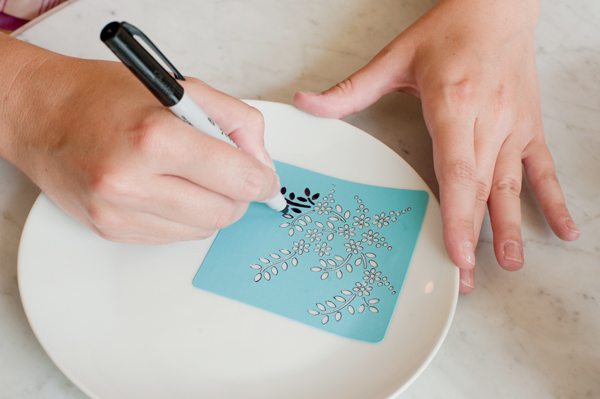
Apparently, you can write or doodle on dinnerware with a Sharpie marker and bake it at 350°F (180°C) for 30 minutes and the design will stay permanently.

Use white crockery. Make sure it is clean and absolutely grease-free. Remove any stickers.

Any colour Sharpie will do.

Don't know if the result is food-safe.

May not be permanent on some crockery; do a test first. Hasn't been tested in a dishwasher, but appears to be safely washable by hand.

I found it here, where you can see some examples. Cool idea; I must definitely try it.

Wednesday, February 27, 2013

Saturday, February 2, 2013

Oldie but goodie

I bought myself this old beech rebate plane today, for about twenty-five bucks. I see them around in antique/junk shops a lot; they're not rare, but they're often in pretty sorry condition. This one is pretty good.

The blade needed a fair bit of attention; the back was pretty far from flat, and of course it was hopelessly blunt. Still, there wasn't too much rust or pitting, which is the main thing.

I'm not experienced with these old wooden planes, and I have to say that they're not easy to use — all your blade adjustment is by careful tippy-tappy on the tang of the blade, and it's just held in place by friction, so it's easy to get it out of whack again. I don't think it will be replacing my electric router, but it will probably be useful for touch-up work and the like.

My respect for Olden Tymes cabinetmakers increases every time I try to use the tools they used every day.

Sunday, January 20, 2013

Dinner knife

This is an old dinner knife I now use as a stiff palette knife, and for cutting putty and that sort of thing.

You may be wondering why I would want to display such a mundane, tatty old thing to the world at large.

Well, it's because I think it's pretty cool.

The handle is caseine, a plastic-like substance derived from milk. That suggests that the age of the knife is somewhere in the 80 to 120 years range; I suspect from the shape that it was probably manufactured in the 1920s or thereabouts, but I'm not 100% sure of that. Caseine doesn't respond well to being left wet, and that's probably what created the ulcer-like cavity in the handle. The length is ideal to sit comfortably against the heel of the hand, with the forefinger against the back of the blade to exert pressure and control.

The blade is stainless steel, which wasn't used for cutlery much before World War One (it was discovered in Sheffield in 1912), though by the twenties it was very common. It's an elegant shape, it cuts and spreads well, and it holds a modest edge and is both stiff and flexible. I haven't tried sharpening it, but I doubt that it would take or keep a real razor edge — though I might give it a go one of these days.

It's engraved on the blade:
SHEFFIELD
Bennett & Heron
ENGLAND

STAINLESS
DELUXE

HAND
GROUND

I really like the fluting around the collar of the blade, where it butts up against the shoulder of the handle. It catches the light nicely, and it provides a good, firm finger grip.

The weight and balance of the knife is very satisfying in the hand; not too heavy, nor yet too light. The slight curve of the blade allows one to maintain easy, close control over cutting. The thickness of the blade decreases toward the tip, so it cuts well and exerts considerable pressure without flexing over-much.

The forward three-fifths of the back of the blade is bevelled on the left; I don't know quite why. It does look nice, which may be the only real reason for doing it.

This simple thing, a mass-produced dinner knife, probably one of thousands, or even millions made, is a wonderful piece of aesthetic and functional design. I just love it for that, and also for the patina of wear that it has amassed over the decades.

After I kick off, it will probably just be thrown away. That's such a pity.

Monday, January 7, 2013

The Ascent of Man


I'm in the process of watching Jacob Bronowski's "The Ascent of Man", originally broadcast in 1973 (which is about when I first saw it on TV at the ripe old age of 11 or 12). It's an interesting experience; it's much more measured and academic than modern documentaries of a similar ilk, and often requires much more close attention to follow.

Some of the information is outdated of course, owing to science not being immovably static like, say, religious dogma — he talks, for example, about the 92 elements of the Periodic table, and the planet Ceres. Some social and biological evolutionary theories have moved on a bit since then too. Overall though, it's still pretty informative as long as you know enough to know roughly what the current state of knowledge is.

The film-making is a sometimes unintentionally amusing mix of static talking-head shots and very groovy 60s-70s style arty-farty sound and vision... the first episode included Pink Floyd's Astronomy Domine in the soundtrack :)

The main thing about it that really grates though is the omnipresent and quite unconscious sexism. Everything is "Man" and "he" and "him" and "his". Women might as well not exist at all, and although I keep telling myself that he was a product of his time and that we've progressed significantly since then, it's nevertheless getting on my tits a bit.

Still, interesting stuff.

Sunday, December 16, 2012

Saw-stool of DOOOOOOM... and more booty

I bought a couple of cheap kitset saw-stools (you may know them as saw-horses) from Bunnings a while ago. They are, not to put too fine a point on it, pretty crap, but they can still serve as trestles.

In the spirit of "if you want something done right, do it yourself", I went ahead and made this for myself. The top and legs are all 50mm pine, and the top is about 400mm wide and a metre long, so it can serve as an impromptu work bench, or I can set up my mitre saw on it and all that sort of thing.

Being so big and heavy, it's a bit of a pain to hump about, but I'll take that in exchange for having a good, solid, portable(ish) work surface available.

Sitting on top of it is my latest score: another Record woodworker's vice, from the same place as I got my other one. This one is a bit smaller, a No.52, but otherwise basically the same. It could do with a bit of cleaning up, but there's no rust that I can see, and it's all square and in pretty good nick. Having more than one vice on one's work bench comes in very handy all the time, so I'm glad to have found this one to act as my secondary emergency back-up thing-holder-and-squeezer.

Thursday, December 13, 2012

Camping Trailer

This is kind of cool, in a dorky kind of way. I' want one.

Friday, November 30, 2012

Koch-ein-düdel-dü!


I'm pondering just what sort of stats to give this guy for use as a PC-chomper, and whether he would have any abilities beyond his ludicrous mandibles. I'm thinking smallish, maybe chicken-sized, and appearing in flocks of up to a couple of hundred.

Thursday, November 29, 2012

More woodwork


I just made this little worktable for Annette, to replace the shitty bargain-warehouse piece of crap she's been using ever since the earthquakes forced us to rearrange our whole lives. It's radiata pine ( a much under-appreciated timber in this country, I feel), and it took me a couple of days of ambling, low-stress endeavour to machine and assemble. It still needs to be oiled up with three or four coats of linseed or tung-based finishing oil; that will take another couple of days at least.


It has a wide, shallow drawer in front for pens and pieces of paper and what-not. It's only 35mm deep, which hopefully will save it from the fate of most drawers, which is to become choked with so much useless crap that nothing can ever be found in them.

The drawer has a cove cut behind its lower edge, to get your fingers into to pull it open. That way it doesn't need any handle sticking out, and the front can stay flush and clean.


The top has a a deep (50mm) splay, leaving only a thin, delicate 8mm edge showing.

That could be a concern; pine being so soft, such a thin edge could be prone to damage. We'll see how it goes; if need be, I can always plane it back a bit.

Sunday, November 25, 2012

Sin Was All I Knew

She doesn't seem to be particularly worried about that.

Sunday, November 18, 2012

Booty

Today Annette and I went out for a picnic, at a little tarn out towards Arthur's Pass. It was bloody freezing, but nice.

On the way back we called in at a bric-a-brac shop at Darfield, where I found these.

The vice is a Record 52½, in very good nick, and it cost me $128 — about a third of what it would cost me to buy one new. I've been looking for a decent vice for ages, so this is an excellent score for me.

The brace is also in excellent nick. Because nobody much uses them any more, they're a lot more expensive to buy than they used to be... Bunnings has them for $175. This one cost me $24, and the lady threw in the bits for free.

All in all, a very productive picnic.

Saturday, November 17, 2012

Blackboard

I just made this blackboard to replace the soulless (yet efficient) whiteboard that hung in our kitchen for writing grocery lists and what-not on.

The frame is pink birch, the little chalk shelves are made from beech. The blackboard itself is just 6mm MDF slathered with blackboard paint.


Wednesday, November 7, 2012

Aaaaaaand...... relax.

In spite of his many failings, and in spite of his inability to overcome a gigantic shitpile of obstruction from the lunatic fringe (big, big fringe... like Cousin It's fringe) of the Republicans in Congress (or the Senate? I'm a bit hazy about U.S. political systems), I'm profoundly relieved that Obama has managed to retain the presidency.

That Romney guy, there's something about him that just makes my skin crawl, and whenever he does his "sincere" face I throw up a little bit in my mouth.

Thursday, October 25, 2012

Toilet humour

There's no way he'd fit in our think-plan chamber.
Imagine how much toilet paper he'd use.

Saturday, October 13, 2012

Press Dream


This is a picture by Karl Larsen, from 1910, of his workshop. I'd really love to get back into intaglio printing, but I don't have anywhere I could keep a full-sized press. Something like that little one he has mounted on his table would be fantastic though; I've never been all that bothered about doing large images anyway.

There are people who make presses in that sort of size range, and from what I've seen of them, they look pretty good. However, even a weensy press like that costs two or three grand to buy brand new, and that's way more money than I could swing.

I do wonder if it would be possible to make one oneself. They're not mechanically complex, and the biggest issue would be cutting the heavy-gauge steel one would need for the frame. I suppose one might also need access to a lathe to smooth and polish the rollers, but maybe not.

I'm becoming increasingly frustrated by not having a decent workshop space. Grr.

Friday, October 12, 2012

Lovely Emma

I've had the most massive crush on Emma Thomson ever since I saw her in The Balkans Trilogy on telly in the early 80s. Here she is reminiscing with and tormenting Stephen Fry on QI.


Friday, September 7, 2012

Chest


Behold, the mighty Games Chest! This is the most recent Thing I Made, and is now full of most of my board-games, dice and such-like.

The top is veneered in various woods — from centre outwards they're burr walnut, kahikatea, mahogany, kahikatea again, black walnut, and then more kahikatea. The little rectangular bits in the centre of each edge is silky oak I think, or possibly rewarewa — they look quite similar sometimes.

The framework is pink birch, and the panels are veneered in red oak.


The chest has a sliding till (the drawer-thing with the round tin in it) that slides from side to side on wooden runners. I'm keeping dice, pencils, erasers and what-not in there.

Friday, August 31, 2012

Saturday, August 11, 2012

Tabletop


This is an old table top I painted black some years ago, having intended at the time to scribble all over it with pastels. Then I forgot about it, and it's been sitting out in the weather all this time. As you can see, the paint is mostly falling off — that's because I was too lazy to prep the surface properly before I painted on it. The paint would have fallen off even if it had been inside, in a relatively benign environment; it would just have happened a bit more slowly.

Friday, August 10, 2012

Reaper Bones - my first look

I'm a sucker for miniatures. I buy all sorts that I know that I will probably never actually use in a game. I'm also kind of a cheapskate — admittedly, a cheapskate with poor impulse-buying control, but nevertheless.

I suppose it's because when I first started buying gaming figurines, they tended to cost less than a buck apiece, and figures designed especially for wargaming were often as low as 20 cents. That makes modern metal figures seem very, very expensive to me, and when it comes to companies like Games Workshop, ludicrously expensive.

Reaper Miniatures have a very extensive range, mostly of pretty good quality, and for a 21st century company, their prices are fairly reasonable. You're still looking at six to ten yankee dollars for a 25-28mm metal figure though, which is a lot when you want to buy a whole horde of orcs or something.

They've recently started producing much cheaper plastic versions of some of their range. The plastic figure range is called Bones, and I decided to try them out. I bought 3 of the Great Worm (77006), Rats (77016 — you get 6 in a pack), and 5 packs of Kobolds (77010 — also 6 to a pack).

The figures are made of a white polymer of some kind, which is bloody hard to photograph effectively. The Rats and Kobolds, shown here, I eventually laid on the platen of my scanner to get an image that didn't blow out the highlights.

The detail appears a bit softer than I'd expect from metal figures, but to what extent that's due to the modelling, and how much to the nature of the medium I don't know. The detail on the Great Worm (below) looks a lot sharper, but then it's also a much larger figure.

The kobolds, by B. Siens, have been mastered in quite flat poses, which tends to be a feature of injection-moulded plastic figures due to the issues the process has with undercuts — attaining a well-rounded, dynamic figure often requires some pretty tricky multi-part mould-making, and that (of course) increases the production cost.

The Rats are by Sandra Garrity, and are pretty good; the proportions and the three poses provided are suitably ratty.

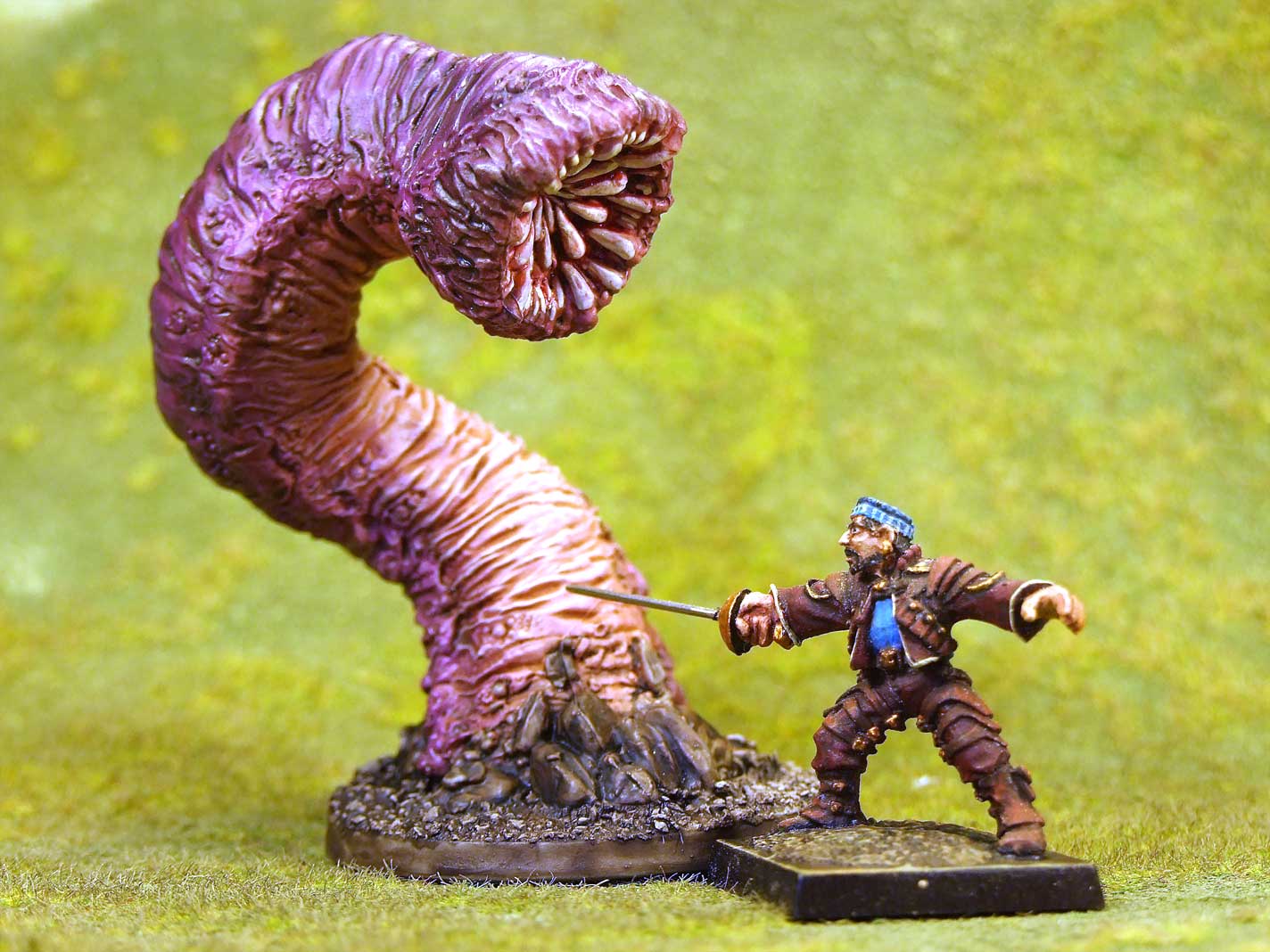
The Great Worm is decently monstrous, and it's with really large figures like this that you stand to save a LOT of money. It costs $US2.99 in plastic, and I doubt that you'd get much change from three or four times that amount if it were made in metal — plus it would weigh a ton, and that means paying extra freight as well.
Reaper say that you can slap paint straight on Bones figures without undercoating, and I certainly didn't have any trouble with the Vallejo acrylics that are my preferred paints these days.

Of the Bones figures I have thus far, I've only painted the Great Worm, shown here with an old WotC metal figure (circa 2001, I think) for scale. The Worm does stand on its own moulded base, but it's slightly out of balance, and I glued it to a honking great steel washer for the sake of stability.

I'm pretty happy with what I've seen of the Bones range so far. I don't think metal figures are going to disappear overnight, but I do think they're going to be reduced to more of a niche market within the next few years, if only because of their expense. A cheaper alternative like these allows me to buy more figures, which means I can throw larger hordes of mooks at my players, and that can't be a bad thing.