I have a very basic, and not very good, vice that I installed as a tail-vice on the end of Workbench #01. Today I added some dogs — a hefty chunk of steel in the vice itself, and some sprung wooden dogs to go in the bench.
The steel dog would have been better in brass or copper, as it would be safer if a plane should hit it. However, I don't have a piece of brass of the required size, so steel it is. It's a piece of 1" x ¼" bar, so somewhat over-engineered for the purpose, but again that's what I had.
One advantage of making a housing in the vice-jaw for such a hefty piece of metal is that I could use a piece of wood in it quite safely — a quarter-inch thick stick of oak or ash should be quite strong enough for the job, and if the steel dog ends up making me too nervous, that's probably what I'll do.
The dog-holes in the bench-top go right through, so sawdust and crap will just fall through instead of clogging them up, and thus far I've bored pairs of holes out to about 450mm from the vice. If I need any further away, they can be bored as and when they're required. The springs in the dogs themselves aren't very potent, but sufficient to hold them in place when they're not under tension from the vice, and that's all they need to do.
Friday, April 27, 2018
Phone Camera — Accidentally Artistic Piece of Crap
My phone is a cheap Huawei of some description, and apart from the fact that Huawei never updates the OS on their phones, it's been an OK phone. However, its camera is complete garbage.
I took this while waiting for some friends at the Blue Duck cafe on Waitangi Day. I've cleaned up the sky a bit, but left everything else untouched. If you look at it full-size, the compression artifacts means that the pine tree foliage has been rendered in quite a painterly fashion, which I quite like.
That doesn't change the fact that the camera is a piece of shit.
Thursday, April 19, 2018
Guillotine
I inherited this nice little guillotine from my friend Robin Sutton, who was doing a great clear-out in preparation for shifting. I believe it was made by his father, or maybe grandfather (?)
Anyway, now it's mine. I've wanted a paper guillotine for years, but have never found one that I could afford.
It was a bit sad when it came to me, but a bit of cleaning up has made it quite cheerful again. I cleaned and polished all the metalwork, sharpened the blades, took a card-scraper to the platen, planed off all the edges of the platen, gave it some feet so that the blade doesn't hit the table when closed, and gave all the woodwork a few coats of shellac and/or oil.
Now it's as good as new (or old). It's much cleaner now, but it still has that patina of use that I like in a tool.
Anyway, now it's mine. I've wanted a paper guillotine for years, but have never found one that I could afford.
It was a bit sad when it came to me, but a bit of cleaning up has made it quite cheerful again. I cleaned and polished all the metalwork, sharpened the blades, took a card-scraper to the platen, planed off all the edges of the platen, gave it some feet so that the blade doesn't hit the table when closed, and gave all the woodwork a few coats of shellac and/or oil.
Now it's as good as new (or old). It's much cleaner now, but it still has that patina of use that I like in a tool.
Friday, March 16, 2018
Knobby Knobs
I've been getting some practice on my little lathe, turning some drawer-pulls for my little chest of drawers. I actually ordered some cast metal ones, but those cost very little so I figured that I had nothing much to lose by making some of my own, and it would be nice to have a piece of furniture in which every single component was made by hand, by me..
There are enough here for all ten drawers, plus some spares so I can discard the crappiest ones. They're made from beech, from an old broom handle.
Some of them are fairly similar to some others, but none are identical — I have real problems with control and repeatability on the lathe. I decided that since I was unlikely to get them all very similar, I wouldn't even try, and made each one an individual.
There are enough here for all ten drawers, plus some spares so I can discard the crappiest ones. They're made from beech, from an old broom handle.
Some of them are fairly similar to some others, but none are identical — I have real problems with control and repeatability on the lathe. I decided that since I was unlikely to get them all very similar, I wouldn't even try, and made each one an individual.
Monday, March 12, 2018
Drawers
My little chest of drawers is about done now, except for the drawer pulls, which are coming from Far Cathay and won't be here for a few weeks.
All in all, I'm fairly happy with it. I'll be happier still when I can actually use it.
I'm kind of curious to see how the colour of the sapele alters as it ages. Will it darken, or will it fade? I'm all agog. I guess I'll find out in ten or twenty years or so.
All in all, I'm fairly happy with it. I'll be happier still when I can actually use it.
I'm kind of curious to see how the colour of the sapele alters as it ages. Will it darken, or will it fade? I'm all agog. I guess I'll find out in ten or twenty years or so.
In retrospect, it might have been better if I'd made it of such a size that the drawers could accommodate an A4 sheet of paper, but alas, I did not. I guess I'll just have to make another one.
Sunday, March 11, 2018
Back in the olden days....
I was browsing through some ancient photos and found this one of me during my short but illustrious military career. It was taken on my crappy old Instamatic camera, which I think took a tiny 9x9mm negative, and had three aperture settings: bright, normal, and dark.
This would have been 1980, on exercise with Bravo Company just outside Whakatane. I was a platoon signaller at the time, which is why I'm carrying an M16 instead of an SLR — it should have been a Sterling, but I don't think we had any in the armoury.
The radio was an ANPRC-77 set, a heavy and clunky old piece of VietNam-era American kit, as was almost all of our equipment at the time. It had a pathetic range, and coped not at all well with things like hills and dense forest, two things that I'm given to understand are quite common in VietNam, as they are here in New Zealand.
This would have been 1980, on exercise with Bravo Company just outside Whakatane. I was a platoon signaller at the time, which is why I'm carrying an M16 instead of an SLR — it should have been a Sterling, but I don't think we had any in the armoury.
The radio was an ANPRC-77 set, a heavy and clunky old piece of VietNam-era American kit, as was almost all of our equipment at the time. It had a pathetic range, and coped not at all well with things like hills and dense forest, two things that I'm given to understand are quite common in VietNam, as they are here in New Zealand.
Thursday, March 8, 2018
Carcass
A few years ago I got a bunch of free reclaimed timber from an organisation that was clearing out its workshop. Among it was some laminated sapele, which appeared to once have been a counter-top.
It's taken a while to get around to using it, but finally I have, and over the last couple of days I've put together the carcass for a little chest of drawers. Now I just have to make a bunch of shallow drawers.
It's about 600mm tall, and the drawer spaces are only 25mm (35mm for the bottom two), so very shallow. I'll be using them to house my 6mm micro-scale models, so they don't need to be any deeper than that — in fact, deeper drawers would just be more difficult to use for the intended purpose.
The runners are ash, so should be tough enough to stand up to plenty of wear, though in truth they won't have to carry a lot of weight.
Sapele is quite nice to work with, but it does tend to have a bit of interlinked grain which can make planing a bit tricky — the issue is exacerbated by the fact that these boards are laminated, so fairly often there are strips of wood right next to each other with the grain running in opposite directions. I have to make sure my planes are super-sharp, and taking super-thin shavings. Even so, I was still getting the occasional tear-out, but it's pretty minimal.
It's taken a while to get around to using it, but finally I have, and over the last couple of days I've put together the carcass for a little chest of drawers. Now I just have to make a bunch of shallow drawers.
It's about 600mm tall, and the drawer spaces are only 25mm (35mm for the bottom two), so very shallow. I'll be using them to house my 6mm micro-scale models, so they don't need to be any deeper than that — in fact, deeper drawers would just be more difficult to use for the intended purpose.
The runners are ash, so should be tough enough to stand up to plenty of wear, though in truth they won't have to carry a lot of weight.
Sapele is quite nice to work with, but it does tend to have a bit of interlinked grain which can make planing a bit tricky — the issue is exacerbated by the fact that these boards are laminated, so fairly often there are strips of wood right next to each other with the grain running in opposite directions. I have to make sure my planes are super-sharp, and taking super-thin shavings. Even so, I was still getting the occasional tear-out, but it's pretty minimal.
Friday, March 2, 2018
Hexapodal Cyclopean Tongue-beast
The latest major update to Photoshop has made a lot of changes to the way brushes are handled, and I've had to do a bit of playing around to get back a group of brushes that I like, and that will react the way that I expect. I've recently changed my graphics tablet too, which might also have something to do with it.
This thing is done with a pencilish sort of brush that I'm finally more or less satisfied with. I have no idea what it is, but I expect it will probably end up in my D&D game in one way or another.
Thursday, March 1, 2018
Winding Sticks
This is a very useful tool, designed to determine if a piece of wood has any twist, or wind, along its length. They're called winding sticks.
I've been making do with bits of scrap wood, and you can get by with them, but these make the job a lot easier and more precise.
I've made these out of rimu. The white tabs are bits of PVC, inlaid into the body of the stick and planed flush; they're intended to be very easy to see. Back in the old days, they would probably have been bone. The black strip is just paint; I would have liked to use an ebony inlay, but that would really just be fanciness for its own sake, and the paint does the job perfectly well. The centering dots are bits of 5mm pine dowel, glued into holes drilled right through both sticks.
Using the sticks is very quick and easy. They're laid across the plank at either end, with the dot at the centre — that ensures that there isn't inadvertently more of the stick on one side than the other, which might unbalance it and give you a false reading.
You lower your eye-line to level with the front stick (the one with the black line), and so that you can just see the white tabs on the back stick. The black line isn't absolutely necessary, but it does give you a very clear reference horizon, differentiating the top of the front stick from the top of the back one.
If there's a difference in the amount of each white tab you can see, then it means that the plank is twisted. In this case, the right tab is higher than the left, which indicates that the rear right corner of the plank is higher. The piece of wood will need to be planed to bring both tabs to level.
The length of the winding sticks exaggerates the degree of twist due to their length, and makes it really obvious. There's a difference in height here between the two tabs of just a few millimetres, and the sticks are about five times as wide as the piece of wood, so that means the difference you see is actually about five times the actual height of the corner. This would only need a few strokes of the plane to bring it back into level.
I've been making do with bits of scrap wood, and you can get by with them, but these make the job a lot easier and more precise.
I've made these out of rimu. The white tabs are bits of PVC, inlaid into the body of the stick and planed flush; they're intended to be very easy to see. Back in the old days, they would probably have been bone. The black strip is just paint; I would have liked to use an ebony inlay, but that would really just be fanciness for its own sake, and the paint does the job perfectly well. The centering dots are bits of 5mm pine dowel, glued into holes drilled right through both sticks.
Using the sticks is very quick and easy. They're laid across the plank at either end, with the dot at the centre — that ensures that there isn't inadvertently more of the stick on one side than the other, which might unbalance it and give you a false reading.
You lower your eye-line to level with the front stick (the one with the black line), and so that you can just see the white tabs on the back stick. The black line isn't absolutely necessary, but it does give you a very clear reference horizon, differentiating the top of the front stick from the top of the back one.
If there's a difference in the amount of each white tab you can see, then it means that the plank is twisted. In this case, the right tab is higher than the left, which indicates that the rear right corner of the plank is higher. The piece of wood will need to be planed to bring both tabs to level.
The length of the winding sticks exaggerates the degree of twist due to their length, and makes it really obvious. There's a difference in height here between the two tabs of just a few millimetres, and the sticks are about five times as wide as the piece of wood, so that means the difference you see is actually about five times the actual height of the corner. This would only need a few strokes of the plane to bring it back into level.
"Owl Sense" Cover
I've just received a copy of a book called Owl Sense by Miriam Darlington. It appears to be about owls. Definitely owl-related.
The reason they sent it to me is because I contributed graphics to the cover art. The tree in the background is a lift-ground etching I did some years ago.
It's nice to see one's work in published form.
The reason they sent it to me is because I contributed graphics to the cover art. The tree in the background is a lift-ground etching I did some years ago.
It's nice to see one's work in published form.
Wednesday, February 28, 2018
The Little Cabinet That Could
A few years ago I bought a whole lot of 6mm WWII models at the Christchurch Wargaming Club's annual bring-and-buy, and they came in some simple trays made of pink birch and hardboard. Those trays have been sitting around doing nothing ever since, and yesterday I thought I might as well make use of them for their original purpose.
I whipped up a carcass from MDF (boo! hiss!), slapped some handles and oil on the trays to turn them into drawers, and voila, a little cabinet for my tiniest war-dollies.
MDF has many virtues, but it has many faults as well. Among those faults, the fact that it's a real pain to get a decent, even paint coat on. Especially if, like me, you're basically pretty crap at painting things that aren't models.
I whipped up a carcass from MDF (boo! hiss!), slapped some handles and oil on the trays to turn them into drawers, and voila, a little cabinet for my tiniest war-dollies.
MDF has many virtues, but it has many faults as well. Among those faults, the fact that it's a real pain to get a decent, even paint coat on. Especially if, like me, you're basically pretty crap at painting things that aren't models.
Thursday, February 8, 2018
Kerfing Saw
Here's my most recent tool-making project — a kerfing saw, or kerfing plane. It's intended for creating a saw kerf around a plank, for re-sawing, or for cutting off a box lid, or any of those sorts of jobs where a straight, accurate saw line is needed. This tool doesn't need to be able to saw right through a piece of wood; it's intended to provide a guide line for a hand-saw to finish off.
The blade is taken from a Bahco gents saw, which cost me about ten bucks. It's ideal for this purpose, because it's quite thin, and sharpened in an unaggressive rip pattern, which means that although it won't cut very fast, it will cut in both directions. I drilled a couple of holes in it and mounted it on a pair of 8mm bolts and wingnuts in slots through the body of the plane, so the amount of blade showing (and therefore the depth of cut) can be adjusted.
The body of the plane, and the fence, are made from offcuts of ash I had left over from another job.
I think I'll add some glue blocks along the inside of the gusset on the fence bracket, just to give it a bit of added strength. Also, I might replace the hex-head bolts with coach-bolts, just because the domed heads will look a bit nicer, I think. That's a pretty low priority though, as it's purely for aesthetics.
The blade is taken from a Bahco gents saw, which cost me about ten bucks. It's ideal for this purpose, because it's quite thin, and sharpened in an unaggressive rip pattern, which means that although it won't cut very fast, it will cut in both directions. I drilled a couple of holes in it and mounted it on a pair of 8mm bolts and wingnuts in slots through the body of the plane, so the amount of blade showing (and therefore the depth of cut) can be adjusted.
The body of the plane, and the fence, are made from offcuts of ash I had left over from another job.
I think I'll add some glue blocks along the inside of the gusset on the fence bracket, just to give it a bit of added strength. Also, I might replace the hex-head bolts with coach-bolts, just because the domed heads will look a bit nicer, I think. That's a pretty low priority though, as it's purely for aesthetics.
Wednesday, January 31, 2018
Enoch Elevated
I gave Enoch a bit of a plinth to make him a bit more stable.
I don't know what sort of wood it is; it used to be a fence-post.
I do know that it has fine, almost invisible checking throughout, which makes it quite unsuitable for any kind of fine turning. This piece is one that I already started turning into a cup, but bits of it just kept flying off, so now it's pretty much just a round block.
I don't know what sort of wood it is; it used to be a fence-post.
I do know that it has fine, almost invisible checking throughout, which makes it quite unsuitable for any kind of fine turning. This piece is one that I already started turning into a cup, but bits of it just kept flying off, so now it's pretty much just a round block.
Saturday, January 6, 2018
Huion 1060 Plus graphics tablet: review
A few months ago I finally caved and upgraded from Windows 7 to Windows 10.
I'd tried Win10 before, when they were doing their intensive free-upgrade marketing, but went back to Win7 simply because my old (maybe fifteen years old) Wacom Intuos tablet lost all pressure sensitivity in Photoshop, and nothing I did could get it back. Wacom were no help; they haven't produced any updated drivers for that tablet for years.
The situation was somewhat improved with recent versions of Win10, as the Intuos worked just fine in conjunction with Windows Ink, Win10's own native tablet control software. In everything except Photoshop. I suspect this is just lazy bloody-mindedness on Adobe's part; the fact that the tablet works OK in every other application indicates to me that they could do the same if they chose, but choose not to.
Anyway, I just worked around Photoshop's intransigence for a while, but then decided to buy a new tablet. There's no way I could afford another Wacom, so I went searching for something cheaper, but still capable. The one I settled on is the Huion 1060 Plus.
It's slightly larger overall than my old Intuos, but much more of that footprint is taken up by working area, and the form-factor is better suited to modern landscape monitors. It's not a wireless tablet, unlike most these days, but I don't mind that — the Intuos was a corded tablet, and I've found that wireless models have a tendency to get laggy when the strain goes on. The Huion claims a resolution of 8192 levels of sensitivity and about 5000 samples/second, but I haven't really noticed any particular improvement in feel over the old Intuos' 1024.
One lack that is significant: the Huion doesn't appear to support tilt sensitivity at all. That's not a major deal for most of my work, but I have made use of it from time to time, and it's a pity not to have it.
There are 12 configurable shortcut buttons on the left of the working area. They're not something I'm likely to have need of; I tend to use the keyboard for all of that.
The tablet has 8GB of internal storage (in which are stored the driver installation files; something none of the installation instructions thought to mention). 8GB isn't a huge amount, but it would be enough to store a few images if you were moving the tablet from machine to machine.
The Huion's pen is actively powered, unlike the passive pen of the Intuos, and it lacks the eraser nib on the back end that has become pretty standard for pretty much every other tablet pen I've seen. Its eraser function is moved to one of the side buttons, the other of which is the "right-click" button. It's not as comfortable to use as the Intuos' pen, but it's not terrible. The pen is recharged via its own proprietary USB cable, which is something I'm going to have to be sure to keep track of, since I very much doubt I could replace it easily if I lost it.
All in all, the Huion is not as good as a Wacom tablet, even one as old as mine. However, it did only cost about a sixth of what I would have to pay for a comparable Wacom, and it's certainly good enough for 99% of my requirements. It would be great if I could have both tablets installed at once, so that I could use the Intuos in the apps that it works in, but alas, they do not work or play well together.
Note: before I found the installation files in the tablet's internal storage, I tried to download the drivers from Huion's website. The site is incredibly slow and unreliable; I tried twice to get the 8MB of files, and both times I ended up with zip files that were prematurely terminated at about the half way point, having taken about half an hour each time to get that four megabytes of data before they were cut off.
I'd tried Win10 before, when they were doing their intensive free-upgrade marketing, but went back to Win7 simply because my old (maybe fifteen years old) Wacom Intuos tablet lost all pressure sensitivity in Photoshop, and nothing I did could get it back. Wacom were no help; they haven't produced any updated drivers for that tablet for years.
The situation was somewhat improved with recent versions of Win10, as the Intuos worked just fine in conjunction with Windows Ink, Win10's own native tablet control software. In everything except Photoshop. I suspect this is just lazy bloody-mindedness on Adobe's part; the fact that the tablet works OK in every other application indicates to me that they could do the same if they chose, but choose not to.
Anyway, I just worked around Photoshop's intransigence for a while, but then decided to buy a new tablet. There's no way I could afford another Wacom, so I went searching for something cheaper, but still capable. The one I settled on is the Huion 1060 Plus.
It's slightly larger overall than my old Intuos, but much more of that footprint is taken up by working area, and the form-factor is better suited to modern landscape monitors. It's not a wireless tablet, unlike most these days, but I don't mind that — the Intuos was a corded tablet, and I've found that wireless models have a tendency to get laggy when the strain goes on. The Huion claims a resolution of 8192 levels of sensitivity and about 5000 samples/second, but I haven't really noticed any particular improvement in feel over the old Intuos' 1024.
One lack that is significant: the Huion doesn't appear to support tilt sensitivity at all. That's not a major deal for most of my work, but I have made use of it from time to time, and it's a pity not to have it.
There are 12 configurable shortcut buttons on the left of the working area. They're not something I'm likely to have need of; I tend to use the keyboard for all of that.
The tablet has 8GB of internal storage (in which are stored the driver installation files; something none of the installation instructions thought to mention). 8GB isn't a huge amount, but it would be enough to store a few images if you were moving the tablet from machine to machine.
The Huion's pen is actively powered, unlike the passive pen of the Intuos, and it lacks the eraser nib on the back end that has become pretty standard for pretty much every other tablet pen I've seen. Its eraser function is moved to one of the side buttons, the other of which is the "right-click" button. It's not as comfortable to use as the Intuos' pen, but it's not terrible. The pen is recharged via its own proprietary USB cable, which is something I'm going to have to be sure to keep track of, since I very much doubt I could replace it easily if I lost it.
All in all, the Huion is not as good as a Wacom tablet, even one as old as mine. However, it did only cost about a sixth of what I would have to pay for a comparable Wacom, and it's certainly good enough for 99% of my requirements. It would be great if I could have both tablets installed at once, so that I could use the Intuos in the apps that it works in, but alas, they do not work or play well together.
Note: before I found the installation files in the tablet's internal storage, I tried to download the drivers from Huion's website. The site is incredibly slow and unreliable; I tried twice to get the 8MB of files, and both times I ended up with zip files that were prematurely terminated at about the half way point, having taken about half an hour each time to get that four megabytes of data before they were cut off.
Wednesday, December 27, 2017
From Useless Rasp to Useful Marking Knife
I have a set of really terrible wood rasps that I bought very cheaply years and years ago. They're bad rasps.
I finally got around to making the flat one a useful tool by cutting it up and grinding off its teeth and turning it into a marking knife.
The only issue with it is that the divots left behind after grinding it flat means that it can't be ground sharp with a single bevel; it has to be beveled on both sides, or else the divots will create notches in the edge. I can live with that, but it would be better made from a very fine mill file or an old chisel.
Wyvern
I drew this wyvern for my AD&D campaign journal. It's based on a render of a critter I found on the internet, but unfortunately I don't know who did that original design. I've made my one a bit knobblier though.
It's all been done digitally in Krita, a free open-source paint program that I highly recommend.
Sunday, December 10, 2017
Paper Towel Holder
![]() |
| In all its naked glory |
![]() |
| Fulfilling its purpose |
The base is about 160mm in diameter and 50mm thick, and that much mass of oak is sufficient to create a bit more vibration in the lathe than I've been used to — especially before I realised I hadn't screwed the wood hard up to the face-plate on one side, so everything was turning slightly skewed. It got a bit better after I attended to that, but I don't think my little lathe would be very happy with anything much bigger than this.
Friday, December 8, 2017
Rough-Sawn Macrocarpa Stool
This is a stool entirely for the Outside, that I whipped up in a few hours from a macrocarpa board I found hiding away down the back of the section.
It's very simple, and as far as is possible, without subjecting its users to the dangers of splinters, I've kept the original rough-sawn finish — I've just sanded it down a bit to smooth it off.
I've applied no finish to this one. I'll just leave it out in the weather, and over a couple of years it will develop its own silvery weather-beaten patina.
It's very simple, and as far as is possible, without subjecting its users to the dangers of splinters, I've kept the original rough-sawn finish — I've just sanded it down a bit to smooth it off.
I've applied no finish to this one. I'll just leave it out in the weather, and over a couple of years it will develop its own silvery weather-beaten patina.
Monday, December 4, 2017
Three-Legged Stool
I made the legs for this stool playing around on my new lathe, and they're as long as it can manage in its present configuration, which is about 420mm.
I'm not usually all that keen on staining wood; I'd rather just oil it and let the natural grain and colour come out. But this is made out of low-grade H4 treated pine, which has a rather unpleasant murky grey-green cast to it, so I coloured it to disguise that.
The stool is solid and comfortable to sit on, but aesthetically I think the legs could have done with another few degrees of rake.
I'm not usually all that keen on staining wood; I'd rather just oil it and let the natural grain and colour come out. But this is made out of low-grade H4 treated pine, which has a rather unpleasant murky grey-green cast to it, so I coloured it to disguise that.
The stool is solid and comfortable to sit on, but aesthetically I think the legs could have done with another few degrees of rake.
Sunday, December 3, 2017
Chisel Handle
A friend has loaned me a great armful of turning tools (thanks!), some in dire need of some TLC and others needing little more than a scrub up with steel wool and some sharpening.
I've got some of the rustier ones in a vinegar bath right now, and I used some of the cleaner tools to whip up this chisel handle out of white oak. The ferrule is a copper plumber's gland, the striking hoop is a bit of copper pipe.
I don't actually have a need for a chisel handle right at this minute, but I wanted to practice turning to precise sizes (for the ferrule and striking hoop). I'm doing it at the moment with the aid of calipers, but there's a tool that clamps on to a cut-off tool or scraper that makes the process almost idiot-proof, and I'd like a bit of idiot-proofing.
I've got some of the rustier ones in a vinegar bath right now, and I used some of the cleaner tools to whip up this chisel handle out of white oak. The ferrule is a copper plumber's gland, the striking hoop is a bit of copper pipe.
I don't actually have a need for a chisel handle right at this minute, but I wanted to practice turning to precise sizes (for the ferrule and striking hoop). I'm doing it at the moment with the aid of calipers, but there's a tool that clamps on to a cut-off tool or scraper that makes the process almost idiot-proof, and I'd like a bit of idiot-proofing.
Friday, December 1, 2017
New Lathe
I spent all my meagre savings on a small wood-turning lathe for myself. It's pretty good for the price; a decently solid cast-iron construction that gives minimal vibration, and a 5-speed pulley system. The maximum distance between centres is about 420mm, so maybe just long enough to turn a chair leg on — there's an extension available for the bed though, which I may invest in at a later date if I find I need it. The only thing about it that I'm not that impressed with is the tool rest, which is very short, only 150mm (6") long. That will need to be addressed at some stage.
I enjoyed turning when I did it at 'tech, but I've done very little of it, and none at all for years, so what skills I had are now very, very rusty. It's going to take a bit of practice to get my hand back in.
My first very modest practice piece is this awl handle, made from a scrap of oak. The blade is an old 3mm drill bit shank.
Oak is a bit mixed as a turning wood. It's hard enough to cut crisply, but it has a fairly open grain, so the surface never looks as smooth and clean from the knife as fruit woods like apple or cherry. However, that's what I've got, so that's what I'm practicing on.
I enjoyed turning when I did it at 'tech, but I've done very little of it, and none at all for years, so what skills I had are now very, very rusty. It's going to take a bit of practice to get my hand back in.
My first very modest practice piece is this awl handle, made from a scrap of oak. The blade is an old 3mm drill bit shank.
Oak is a bit mixed as a turning wood. It's hard enough to cut crisply, but it has a fairly open grain, so the surface never looks as smooth and clean from the knife as fruit woods like apple or cherry. However, that's what I've got, so that's what I'm practicing on.
Tuesday, November 28, 2017
Mitre Saw Wheely-Stand Thing
I've had my mitre saw clamped to a folding workbench thingy (basically a cheaper version of the Black & Decker Workmate) for years. That was fine, but it was troublesome to shift around, and in my rather cramped little workshop I need to be able to shift things around so that they don't interfere with each other when I'm trying to use them.
So, I made this stand out of el-cheapo treated framing timber and some unexpectedly expensive locking castors. It doesn't look like much, but it's sold as a rock, and it gave me lots of practice at cutting mortice & tenon joints, bridle joints and lap joints.
We have bamboo growing in our garden, and I thought I'd use some as railings for the upper shelf, to stop things being pushed out the back or falling out the sides. Bamboo is good for that sort of use, as it's both thin and strong, and it will get stronger as it seasons. The down-side to it is that nature is distressingly imprecise in its sizing, and I had to do quite a bit of searching to get canes that were all within a size range that would fit my available drill holes.
As a side-effect of all this, I got my clamps a bit more organised and accessible. Next, I'll have to get a concrete pad under where the saw usually stands — at the moment it's sitting on various bits of wood spanning the rotten boards underneath, which isn't ideal.
So, I made this stand out of el-cheapo treated framing timber and some unexpectedly expensive locking castors. It doesn't look like much, but it's sold as a rock, and it gave me lots of practice at cutting mortice & tenon joints, bridle joints and lap joints.
We have bamboo growing in our garden, and I thought I'd use some as railings for the upper shelf, to stop things being pushed out the back or falling out the sides. Bamboo is good for that sort of use, as it's both thin and strong, and it will get stronger as it seasons. The down-side to it is that nature is distressingly imprecise in its sizing, and I had to do quite a bit of searching to get canes that were all within a size range that would fit my available drill holes.
As a side-effect of all this, I got my clamps a bit more organised and accessible. Next, I'll have to get a concrete pad under where the saw usually stands — at the moment it's sitting on various bits of wood spanning the rotten boards underneath, which isn't ideal.
Wednesday, November 22, 2017
What I Did Today
This afternoon I shifted a whole lot of wood and crap so I could shift some drawers so I could shift some bins so I could shift my mitre saw so I could shift those drawers again so I can use my table saw without banging bits of wood into things.
For a brief moment I marvelled at the unexpected amount of space I had.
Then I shifted all the wood back in again, which filled up most of that free space, and I realised that most of it is just rubbish so I'll have to go through it and start chucking most of it into the firewood pile.
And that's what I did today. Now I'm drinking cold beer, which is better.
(At some point I'm going to have to lay some more concrete so I can shift a workbench so I can shift my bandsaw to a more usable position, but not just yet. Not just yet.)
For a brief moment I marvelled at the unexpected amount of space I had.
Then I shifted all the wood back in again, which filled up most of that free space, and I realised that most of it is just rubbish so I'll have to go through it and start chucking most of it into the firewood pile.
And that's what I did today. Now I'm drinking cold beer, which is better.
(At some point I'm going to have to lay some more concrete so I can shift a workbench so I can shift my bandsaw to a more usable position, but not just yet. Not just yet.)
Monday, November 20, 2017
Yet Another Stool
I made another stool, this time out of some fairly dodgy, knotty white oak off-cuts. I had to work hard to get some decent lengths out of them, but persistence paid off in the end.
Our stool supply is outstripping the number of bums available to sit on them in normal daily life, but they'll come in handy for perching guests on.
I made many, many mistakes in building this. Perhaps I may learn from them, but who knows?
Our stool supply is outstripping the number of bums available to sit on them in normal daily life, but they'll come in handy for perching guests on.
I made many, many mistakes in building this. Perhaps I may learn from them, but who knows?
Tuesday, November 14, 2017
Stool Sample
I had a macrocarpa plank that was getting in the way, so I turned it into this stool.
For some reason it seems to me that it has a somewhat ecclesiastical feel, probably because of the scallops and what-not.
I like working with macrocarpa, but I can't say I'm especially fond of the knots. They tend to be dead knots too, so they fall out.
The stool is 600mm long by about 450mm high, a very comfortable sitting height for me. It's long enough for two people to sit on, as long as they're two very friendly people.
For some reason it seems to me that it has a somewhat ecclesiastical feel, probably because of the scallops and what-not.
I like working with macrocarpa, but I can't say I'm especially fond of the knots. They tend to be dead knots too, so they fall out.
The stool is 600mm long by about 450mm high, a very comfortable sitting height for me. It's long enough for two people to sit on, as long as they're two very friendly people.
Tuesday, November 7, 2017
Router Plane Revisited
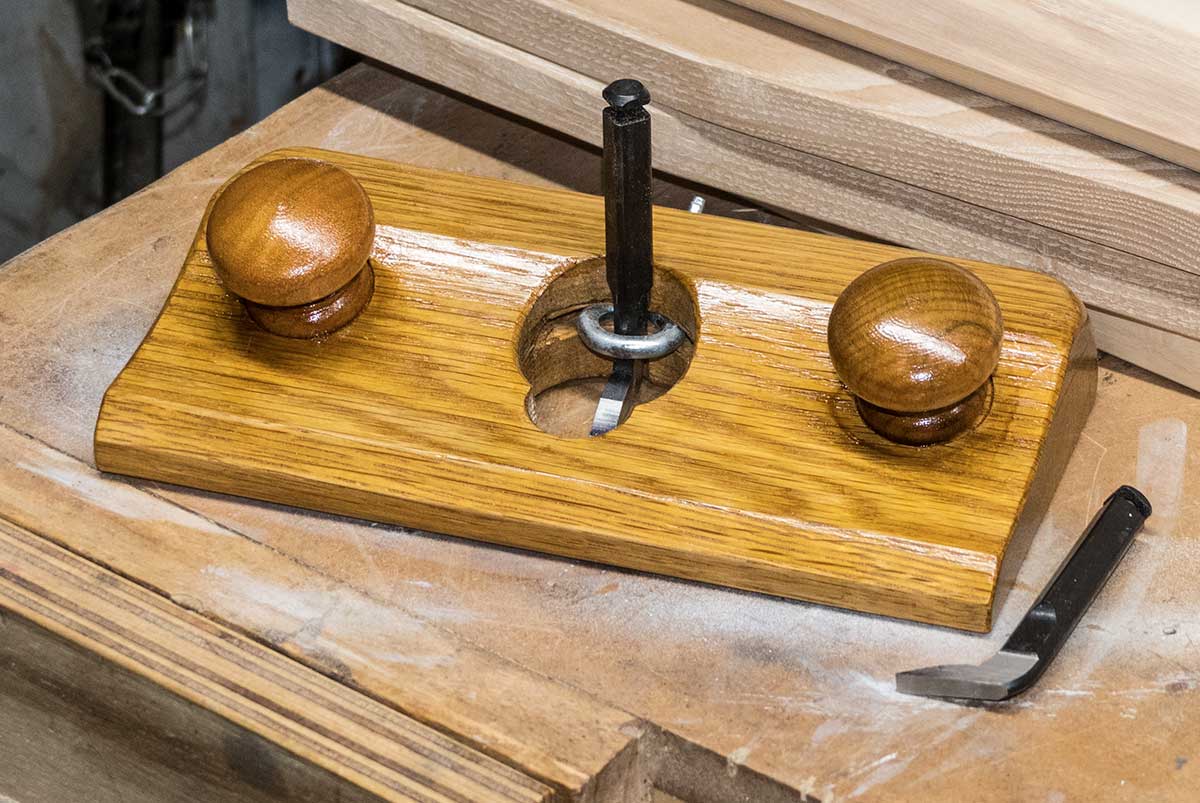
I went back to the oak router plane I made a while ago and added some handles. It worked OK without them, but they give me a bit more control and it's easier on the hands this way. They're just a pair of tawa drawer-pulls.
Because its depth adjustment is by tap-and-hope rather than by means of a screw thread, it's a bit tricky to use with the precision of my Stanley or Record routers, but nevertheless it's pretty smooth and easy to use once you get used to its little quirks.
I'm using Veritas cutters in it, and though they're excellent cutters, they've introduced a complication.
As you can see, the back of the cutter curves forward towards the sole — I'm not sure why, but probably just as a side-effect of the tool's production when they're bent into shape. Anyway, the effect of this is that if the cutter is set to too shallow a depth, when the eye-bolt is tightened, it engages over the curved section and cants the cutter forward, and the edge of the blade is suddenly much deeper than one might have expected.
I have a couple of ideas for ameliorating this issue.
The first is to add a sleeve, anchored to the top of the router, through which the shaft of the blade runs. That should help some, and it's the most straightforward solution, but it won't entirely eliminate the problem because it will have to be fractionally loose on the shaft to allow the cutter's depth to be adjusted at all, and any slack will still allow the cutter to cant forward ever so slightly when it comes under pressure from the eye-bolt.
The second is to cut out the existing eye-bolt housing entirely, and glue in a new block in which a new housing is cut that will engage higher on the shaft of the cutter. I'd say, for safety's sake, the eye-bolt really needs to be engaging at least 10 mm higher up the shaft of the blade. That's a pretty major bit of surgery, and it would probably be quicker and easier just to make a whole new tool, taking into account what I've learned from this one.
Part Two
Part One
Because its depth adjustment is by tap-and-hope rather than by means of a screw thread, it's a bit tricky to use with the precision of my Stanley or Record routers, but nevertheless it's pretty smooth and easy to use once you get used to its little quirks.
I'm using Veritas cutters in it, and though they're excellent cutters, they've introduced a complication.
As you can see, the back of the cutter curves forward towards the sole — I'm not sure why, but probably just as a side-effect of the tool's production when they're bent into shape. Anyway, the effect of this is that if the cutter is set to too shallow a depth, when the eye-bolt is tightened, it engages over the curved section and cants the cutter forward, and the edge of the blade is suddenly much deeper than one might have expected.
I have a couple of ideas for ameliorating this issue.
The first is to add a sleeve, anchored to the top of the router, through which the shaft of the blade runs. That should help some, and it's the most straightforward solution, but it won't entirely eliminate the problem because it will have to be fractionally loose on the shaft to allow the cutter's depth to be adjusted at all, and any slack will still allow the cutter to cant forward ever so slightly when it comes under pressure from the eye-bolt.
The second is to cut out the existing eye-bolt housing entirely, and glue in a new block in which a new housing is cut that will engage higher on the shaft of the cutter. I'd say, for safety's sake, the eye-bolt really needs to be engaging at least 10 mm higher up the shaft of the blade. That's a pretty major bit of surgery, and it would probably be quicker and easier just to make a whole new tool, taking into account what I've learned from this one.
Next Day:
I added a collar to restrain the forward movement of the cutter when the eye-bolt is tightened, and it works well. It's made out of a 100mm (4") nail.
It looks a bit unsightly, I admit, but it does the job, and as an added bonus it ensures the cutter sets square to the cut. It can't be seen from this angle, but there's a vertical groove in the body of the router that ensures that the shaft is square vertically.
As I suspected, it doesn't eliminate the issue completely, as it has to be loose enough to allow the cutter shaft to move up and down, but the unwanted movement when the cutter is set shallow is now minimal, and much easier to compensate for.
Part Two
Part One
Friday, October 27, 2017
Mortise Gauges
I have several mortise gauges. The marking, or mortise, gauge is an incredibly useful tool; it would be possible to get by without one, but it would make one's woodworking life a lot more difficult.
If you don't know what a marking gauge is, it's used to scribe a line, or in the case of a mortise gauge a pair of lines, accurately relative to the edge of a piece of wood. What you do with it is set the block on the shaft at the distance you want the line, and then run the block along the edge of the wood so that the pin (or pins) in the shaft scores a line.
The top one is the first one I ever bought, and the simplest. It's made of beech, manufactured to quite decent tolerances, but it's not that easy to use as a mortise gauge because the secondary mortise pin is free-sliding, which means that you have to hold several things in place at once before tightening it up. It can often take several tries to get everything properly spaced, relative to each other. However, as a simple marking gauge (just using the single-pin side) it's great. I've modified it very slightly by re-shaping the pins from a conical section to spear-pointed triangles, so they cut the fibres of the wood rather than crushing them — this results in a much finer, more accurate line, but being so fine it can be difficult to see. especially in timber with a pronounced grain like oak.
The middle one I was given as a birthday present some years ago. It's quite old, and very well made from rosewood with brass inlays. It has a screw adjustment in the shaft for setting the mortise width, so it's a lot easier to be accurate when setting the relative positions of the block and the two mortise pins. Its only issue is that, being so old, it's been used a lot, and the pins have been sharpened and resharpened so much that they're mere nubbins. They could be replaced, but I'm not really confident enough of my skills to try it — it's not a straightforward disassembly job, and I fear that I might destroy it in the attempt.
The bottom one is one that I just bought by mail-order. It wasn't expensive, about twenty bucks or so, but it should see me out. It's made of Malaysian ebony with good, chunky brass anti-wear inserts on the face of the block. Like my rosewood one, it has a screw adjustment for the mortise pins
It has (or had) one significant issue though: the hole in the block had been machined too large, so the shaft rode quite sloppily in it. That would mean that you couldn't guarantee that everything was square when tightened up.
I fixed that by adding a pair of copper shims, one on either side of the shaft, to tighten everything up. You can see their ends folded around the face of the block (there's a similar flange at the back) to hold them in place. I cut a shallow recess in the face so that the shim rests below the surface of the block; that just ensures that it doesn't accidentally ride against your work-piece and send your line off its proper path.
I'll probably re-shape the pins the same way I've done on my beech gauge, but I'll give it some use first to see if that's really warranted.
If you don't know what a marking gauge is, it's used to scribe a line, or in the case of a mortise gauge a pair of lines, accurately relative to the edge of a piece of wood. What you do with it is set the block on the shaft at the distance you want the line, and then run the block along the edge of the wood so that the pin (or pins) in the shaft scores a line.
The top one is the first one I ever bought, and the simplest. It's made of beech, manufactured to quite decent tolerances, but it's not that easy to use as a mortise gauge because the secondary mortise pin is free-sliding, which means that you have to hold several things in place at once before tightening it up. It can often take several tries to get everything properly spaced, relative to each other. However, as a simple marking gauge (just using the single-pin side) it's great. I've modified it very slightly by re-shaping the pins from a conical section to spear-pointed triangles, so they cut the fibres of the wood rather than crushing them — this results in a much finer, more accurate line, but being so fine it can be difficult to see. especially in timber with a pronounced grain like oak.
The middle one I was given as a birthday present some years ago. It's quite old, and very well made from rosewood with brass inlays. It has a screw adjustment in the shaft for setting the mortise width, so it's a lot easier to be accurate when setting the relative positions of the block and the two mortise pins. Its only issue is that, being so old, it's been used a lot, and the pins have been sharpened and resharpened so much that they're mere nubbins. They could be replaced, but I'm not really confident enough of my skills to try it — it's not a straightforward disassembly job, and I fear that I might destroy it in the attempt.
The bottom one is one that I just bought by mail-order. It wasn't expensive, about twenty bucks or so, but it should see me out. It's made of Malaysian ebony with good, chunky brass anti-wear inserts on the face of the block. Like my rosewood one, it has a screw adjustment for the mortise pins
It has (or had) one significant issue though: the hole in the block had been machined too large, so the shaft rode quite sloppily in it. That would mean that you couldn't guarantee that everything was square when tightened up.
I fixed that by adding a pair of copper shims, one on either side of the shaft, to tighten everything up. You can see their ends folded around the face of the block (there's a similar flange at the back) to hold them in place. I cut a shallow recess in the face so that the shim rests below the surface of the block; that just ensures that it doesn't accidentally ride against your work-piece and send your line off its proper path.
I'll probably re-shape the pins the same way I've done on my beech gauge, but I'll give it some use first to see if that's really warranted.
Wednesday, October 25, 2017
Stool
Today I gave my DeWalt thicknesser its very first outing on its shiny new wheely-stand, and used it to plane down some bits of macrocarpa that I had lying around from another project that never got off the ground.
I put together this sitting-stool, which is shown here having just had its first coat of linseed oil. It will most likely end up being another piece of outdoor furniture; macrocarpa is a good timber for that.
Just as an aside: when I was a kid, I thought macrocarpa was a Maori word, not Latin. I thought it was makorokaporo. I have no idea what, if anything, makorokaporo would mean though.
I put together this sitting-stool, which is shown here having just had its first coat of linseed oil. It will most likely end up being another piece of outdoor furniture; macrocarpa is a good timber for that.
Just as an aside: when I was a kid, I thought macrocarpa was a Maori word, not Latin. I thought it was makorokaporo. I have no idea what, if anything, makorokaporo would mean though.
Saturday, October 21, 2017
Tanto
In my scrap pile today I found a very curly bit of oak. It has grain going about seventeen different ways at once, and was impossible to work with any of the bladed tools I own, so I made this wooden tanto for aikido training entirely with rasps and files.
It's actually a pretty shitty piece of timber for almost any purpose, but I really like the chaotic figure of the grain.
Monday, October 16, 2017
Wooden Router Plane - Finis
I finished off shaping my wooden router plane, and gave it a few coats of shellac and a spot of wax.
It works fine, but it's not going to be taking the place of my trusty Record or Stanley routers any time soon. It'll be purely an emergency backup extra router, in case I should need one.
Part Three
Part One
It works fine, but it's not going to be taking the place of my trusty Record or Stanley routers any time soon. It'll be purely an emergency backup extra router, in case I should need one.
Part Three
Part One
Saturday, October 14, 2017
Making a Wooden Router Plane
This may not look like anything much, but it's actually a fully functional router plane.
Admittedly, it's not a very beautiful router plane just yet, but it works as one, which is the important thing. It has some shaping to be done as yet, now that I know it works as expected, and I also want to add a couple of tee-nuts so that I can mount a grooving fence to it.
The cutter is from Veritas, and is the same format as that for the Stanley No.70 or Record No.71 planes. It's held in place by a ¼" threaded eye-bolt which passes through the body of the router to a wing-nut at the back.
The wing-nut is functional, but uncomfortable, and I'd like to replace it with a knurled thumb-nut at some stage.
I've learned a thing or two from this so far, and I may (or may not) make another.
Part Two
Part Three
Admittedly, it's not a very beautiful router plane just yet, but it works as one, which is the important thing. It has some shaping to be done as yet, now that I know it works as expected, and I also want to add a couple of tee-nuts so that I can mount a grooving fence to it.
The cutter is from Veritas, and is the same format as that for the Stanley No.70 or Record No.71 planes. It's held in place by a ¼" threaded eye-bolt which passes through the body of the router to a wing-nut at the back.
The wing-nut is functional, but uncomfortable, and I'd like to replace it with a knurled thumb-nut at some stage.
I've learned a thing or two from this so far, and I may (or may not) make another.
![]() |
| The cutter and eye-bolt |
![]() |
| The wing-nut |
Part Three
Wednesday, October 11, 2017
Cunning Dovetail Jig
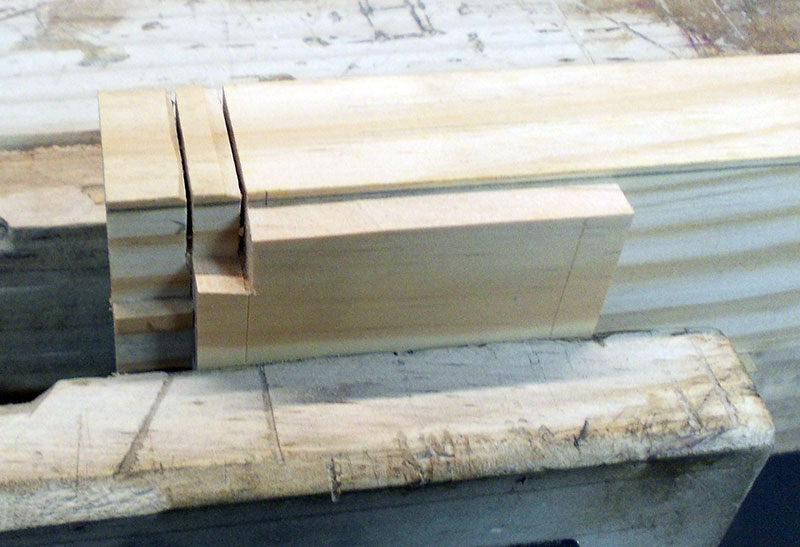
This may not look like much, but in fact it's an amazingly useful and cunning dovetailing jig that makes cutting dovetails a piece of cake. It's a variation on a jig developed by Paul Sellars.
One of the crucial things to get well-fitting dovetails is getting your cuts dead square, which is especially tricky on very thin stock. I've been making a bunch of small boxes out of 8mm thick pine, and 8mm doesn't give you much leeway to gauge your accuracy visually.
The thick base of this jig allows you to get your cuts square every time. Its been marked and cut with one raked cut for a side of the dovetail, and one horizontal cut, for a shoulder. In this instance I only need one tail, but it can be easily expanded for multiple tails.
The piece to be cut is put into the jig, hard up against the side piece and hard up against the top registration peg(s).
Then the saw is offered into the dovetail cut in the jig, and the first cut is made.
The piece is then flipped over, and the cut on the other side of the tail is made the same way.
Again, the piece is flipped over and the opposite cut is made the same way.
There are a couple of changes I'd make for future versions.
One of the crucial things to get well-fitting dovetails is getting your cuts dead square, which is especially tricky on very thin stock. I've been making a bunch of small boxes out of 8mm thick pine, and 8mm doesn't give you much leeway to gauge your accuracy visually.
The thick base of this jig allows you to get your cuts square every time. Its been marked and cut with one raked cut for a side of the dovetail, and one horizontal cut, for a shoulder. In this instance I only need one tail, but it can be easily expanded for multiple tails.
NOTE: The observant will note that there are actually two shoulder cuts, but I realised that by putting a registration peg out in the middle of the tail I'd only need the one.
The piece to be cut is put into the jig, hard up against the side piece and hard up against the top registration peg(s).
Then the saw is offered into the dovetail cut in the jig, and the first cut is made.
The piece is then flipped over, and the cut on the other side of the tail is made the same way.
Note: I'm not left-handed; this is a posed shot for the camera.Next, the whole lot is turned sideways in the vice, and the first shoulder cut is made in the same manner.
Again, the piece is flipped over and the opposite cut is made the same way.
Note: that left-hand cut is one I included before I realised that a registration peg in the middle of the tail would give more accurate symmetry than relying on allowing for the depth of the shoulder with the original corner peg.I didn't time my work, but I'd be surprised if it took more than four or five minutes to complete each piece, with guaranteed accuracy. It would be longer of course if you're cutting multiple tails, but it's still much faster and more reliable than doing it all by eye.
There are a couple of changes I'd make for future versions.
- I'd make the jig back-plate a bit wider, say about 25mm wider than the work piece, so that the saw starts its shoulder cut more reliably square. On this one, there's only a couple of millimetres from the edge of the piece to the edge of the jig, and though it worked OK, more depth would be better.
- The top registration peg in the corner isn't really necessary. A single peg that sits in the middle of the piece's tail is adequate to ensure that everything is properly registered for cutting.
Tuesday, October 10, 2017
Friday, October 6, 2017
Saw Conversion Complete (mostly)
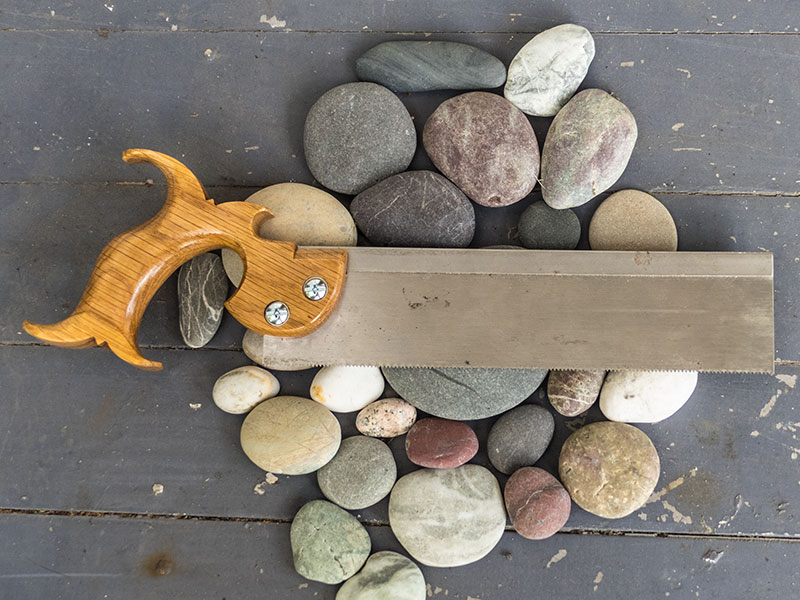
The conversion of my cheap gents' saw into a rather nice dovetail saw is pretty much complete.
It's now completely usable, and it cuts very nicely with a good thin kerf.
Alas, it's still moderately hideous from its left-hand side until I can figure out a decent way to hide the captive square bolts. They don't affect the saw's functionality in any way, but they're aesthetically unpleasing.
Thursday, October 5, 2017
Saw Conversion
I have an inexpensive gents' saw that I'm converting into a pistol-grip dovetail saw. I'll have to remove the saw's handle, cut off the tang and reshape the plate slightly, and then mount it into the new handle I'm in the process of shaping from a piece of 25mm thick oak I had lying around.
The existing saw is OK, though not great. The steel is decent and it cuts well, but its back-spline is a little light. Ideally I'd like to change that for a good stiff, heavy brass one, but I'm not sure that I'm capable. For the moment it can stay with the existing spline; I can always swap it out at a later date with only minor surgery to the new handle.
This is more or less how it will look when it's assembled. Of course, the grip will be shaped so that it's a lot more comfortable to hold.
One thing that's troubling me is the pair of nuts and bolts that should hold the plate to the handle. Traditionally they should be brass split-nuts, in which the bolt (or rather, machine screw) part of the pair screws into a threaded, capped tube. This gives the assembly a very neat look, but as far as I can find they're just not available anywhere in New Zealand except by cannibalizing some from an old saw. I can get some from overseas, but they're quite expensive in themselves, and the postage being demanded by the vendors is eye-watering — one mob in the UK wants £45 in addition to the cost of the fixings themselves!
Well, they're not essential; I want to use them mostly for aesthetic reasons. It would be nice to have some though, not least because I have some missing from some of my other saws that I'd like to replace.
Later....
I finished the shaping of the handle, and gave it a single coat of oil just to seal it.I drilled a couple of small guide holes where the screws will eventually go; there's no point in going any further with them until I know exactly what hardware I've got for them.
Subscribe to:
Posts (Atom)